


We're excited to announce that Node Monster has been selected as a launch validator for NEAR Protocol's Confidential Intents network.
As one of the selected validators for Phase 0 launch, Node Monster will help establish the foundation for a new era of secure, confidential cross-chain interactions that bridge AI agents, DeFi protocols, and real-world applications.
Understanding NEAR Protocol: The Blockchain for AI
NEAR Protocol has emerged as one of the most innovative Layer-1 blockchains in the ecosystem, purpose-built from the ground up to power AI-native applications at internet scale. Founded by AI researchers Illia Polosukhin and Alexander Skidanov in 2018, NEAR has consistently demonstrated remarkable growth and technical innovation:
NEAR's unique architecture combines three core elements that make it the ideal platform for blockchain applications:
- User-Owned AI - ensuring AI agents act in users' best interests
- Intents and Chain Abstraction - eliminating blockchain complexity for seamless, goal-driven transactions
- Sharded blockchain architecture - delivering scalability, speed, and low-cost execution for real-world use cases
What Are NEAR Intents?
Introduced in November 2024, NEAR Intents represent a fundamental shift in how users and AI agents interact with blockchain technology. Rather than constructing complex, low-level transactions directly, users simply express what outcome they want to achieve — their "intent" — and let the network figure out the optimal way to execute it.
The Intent-Based Paradigm
Traditional blockchain interactions require users to:
- Understand specific blockchain protocols and architectures
- Manage wallets, gas fees, and smart contract calls across multiple chains
- Navigate fragmented liquidity pools and bridging solutions
- Execute multiple transactions to achieve simple cross-chain operations
NEAR Intents eliminate all of this complexity. Instead of saying "I need to bridge my tokens from Ethereum to NEAR, then swap them on this specific DEX, and then transfer to Solana," a user simply expresses: "I want to exchange 100 USDC on Ethereum for SOL on Solana."
The NEAR Intents infrastructure then:
- Receives the intent from the user or AI agent
- Broadcasts it to a network of solvers who compete to fulfill the request
- Collects and evaluates fulfillment options based on price, speed, and reliability
- Settles the commitment on-chain with cryptographic guarantees
This architecture leverages NEAR's Chain Signatures technology to enable smart contracts to sign transactions on any blockchain, creating true chain abstraction without traditional bridges.
Key Metrics:
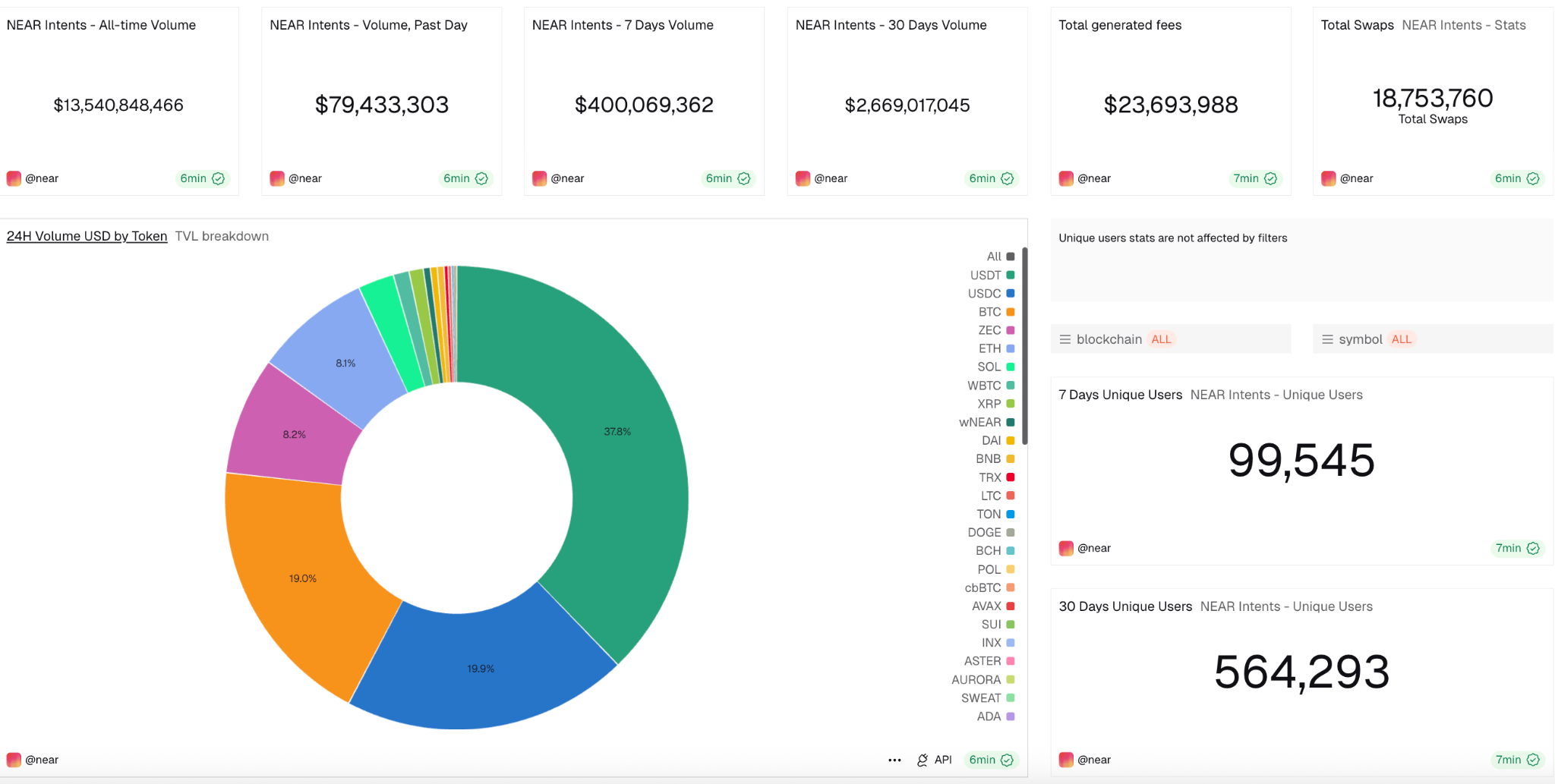
As of February 2026:
- 18.7 million swaps processed across all supported chains
- $13.5 billion in all-time transaction volume
- $23.7 million in fee revenue generated
- 25+ blockchain networks integrated, including Ethereum, Solana, Bitcoin, Dogecoin, Starknet, and Stellar
- 564,293 unique addresses active in the last 30 days, generating $2.6 billion in volume
- Recent 7-day volume: $400 million from ~100k unique users
The system is particularly significant for the emerging AI economy. AI agents can now execute complex financial operations across multiple chains without requiring separate implementations for each blockchain. This lays the foundation for autonomous agents to negotiate, transact, and collaborate seamlessly across Web2 and Web3.
Introducing Confidential Intents: Adding Privacy to the Intent Layer
While NEAR Intents have revolutionized cross-chain interactions, many use cases require an additional critical component: privacy. Users and AI agents need the ability to express and execute intents without exposing sensitive information to public observation.
Consider these scenarios:
- Institutional trading where large orders must be executed without front-running
- Private AI agent coordination where agents negotiate and transact without revealing strategies
- Sensitive financial operations require confidentiality while maintaining blockchain verification
- Enterprise DeFi applications handling proprietary trading strategies or confidential transactions
Phase 0 Confidential Intents: The Architecture
The Phase 0 Confidential Intents network operates as a dedicated private shard (effectively a sidechain) designed to process intents that should not be publicly visible on the NEAR mainnet.
How It Works
User Privacy Flow:
- Users and integrators submit intents to the Confidential Intents network instead of the public NEAR blockchain
- The dedicated validator network processes these transactions while maintaining a private state (balances, nonces, settlement records)
- Only final settlement commitments are posted to the main NEAR blockchain, while transaction details remain private
- Validators process transactions in a secure, isolated environment
Confidential Intents runs on a NEAR private shard running a single smart contract, NEAR Intents, and operated initially by permissioned validators. A TEE-based bridge connects the private shard to NEAR mainnet.
The design eliminates client-side ZK proof generation for simpler wallet UX while preserving cryptographic integrity within a compliance-aware architecture.
Privacy Model: Phase 0 is deliberately designed with a pragmatic approach optimized for fast time-to-market and operational learning. The privacy model is best described as "private from the public" rather than full cryptographic privacy:
- Public users cannot observe the intents, transaction details, or private state
- Validators may be able to see plaintext depending on the execution path (similar to how traditional blockchain validators can see transaction content)
- Trust is distributed across the validator set rather than relying on a single party
- Future phases will implement stronger guarantees through enforced Trusted Execution Environments (TEEs) and/or cryptographic proofs
Node Monster’s Footprint in NEAR
Node Monster has been an active participant in the NEAR ecosystem, operating an MPC (Multi-Party Computation) node for NEAR's Chain Abstraction infrastructure.
The Broader Vision: Privacy-Enabled AI Economy
Use Cases Enabled by Confidential Intents
AI Agent Coordination: Multiple AI agents can negotiate and execute transactions privately, enabling:
- Collaborative problem-solving without exposing strategies
- Multi-agent marketplaces with competitive bidding
- Private auction mechanisms for computational resources
- Confidential data sharing and processing agreements
DeFi Privacy Enhancements:
- Dark pools for large institutional orders
- Private limit orders preventing front-running
- Confidential lending and borrowing arrangements
- Privacy-preserving liquidation mechanisms
Enterprise Blockchain Applications:
- Private supply chain finance
- Confidential B2B payment settlements
- Enterprise DeFi with regulatory compliance
- Cross-border transactions requiring privacy
MEV Protection:
- Intent-based architecture inherently reduces MEV opportunities
- Private execution prevents transaction ordering manipulation
- Fair transaction inclusion through solver competition
Conclusion: Building the Future of Confidential Cross-Chain Transactions
The launch of NEAR's Confidential Intents network in mid-February represents a pivotal moment in blockchain evolution. As transactions increasingly involve AI agents, enterprise applications, and sophisticated DeFi strategies, privacy becomes not just a feature but a fundamental requirement.
Node Monster is proud to be among the carefully selected validators launching this groundbreaking infrastructure. Our deep experience in the NEAR ecosystem, enterprise-grade security infrastructure, and unique geographic positioning make us an ideal partner for this initiative.
