


Understanding EIP-7251 and the Move Beyond the 32 ETH Model
Ethereum’s transition to Proof of Stake was one of the most significant protocol upgrades in blockchain history. Yet, even after The Merge and the introduction of withdrawals, one core assumption remained untouched: every validator was capped at 32 ETH.
That assumption has finally changed.
With the rollout of EIP-7251, also known as the Maximum Effective Balance (MaxEB), Ethereum introduced a new validator paradigm that replaces rigid, unit-based staking with a flexible, balance-based model. This change, implemented through the Pectra and Fusaka upgrades, is more than a convenience feature for large operators; it is a structural response to scaling pressures that threatened Ethereum’s long-term liveness and finality.
This article breaks down what EIP-7251 changes, why it was necessary, who benefits from it, and what new risks it introduces for Ethereum as a global settlement layer.
What Is EIP-7251?
EIP-7251 increases the maximum effective balance of a validator from 32 ETH to 2048 ETH, while keeping the minimum staking requirement unchanged at 32 ETH.
This is enabled through a new validator credential type, known as 0x02 credentials, which allows rewards to automatically compound within a single validator instead of being swept out once the balance exceeds 32 ETH.
In simple terms:
- Before:
One validator = exactly 32 ETH of effective stake - After:
One validator = between 32 ETH and 2048 ETH of effective stake
This decouples validator participation from validator count, allowing Ethereum to reduce network load without reducing total economic security.
Why Ethereum Needed This Change
Since the Beacon Chain launched in 2020, Ethereum experienced overwhelming success in staking adoption. By late 2024, the network exceeded one million active validators.
While decentralization at that scale is impressive, it came with hidden costs:
- Every validator adds memory load to the Beacon State
- Every validator increases peer-to-peer messaging traffic
- Signature aggregation becomes heavier each epoch
Ethereum Foundation simulations showed that at around 2.1 million validators, client software would struggle to maintain finality. This made the validator set contraction not optional, but necessary.
EIP-7251 was designed to reduce redundant validators while preserving open access for solo stakers.
The 0x02 Validator Model Explained
The following table summarizes the technical differences between the legacy 0x01 format and the modern 0x02 format as observed in the current mainnet environment of January 2026.
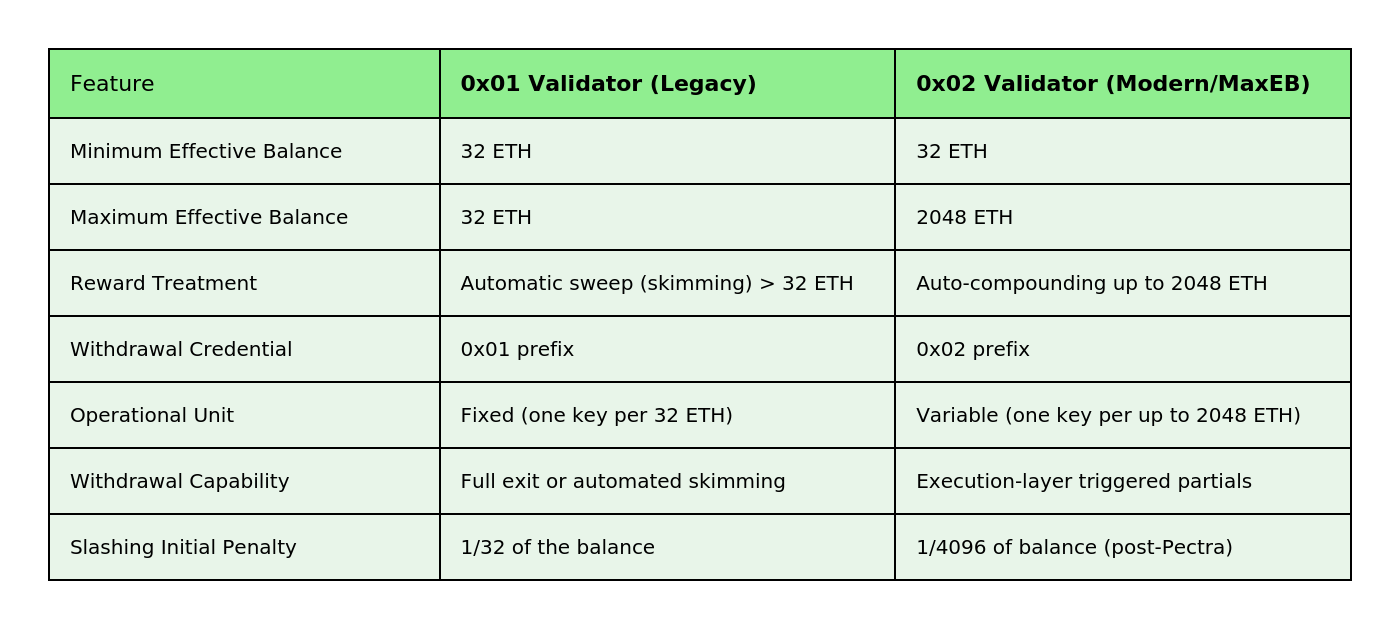
Under the legacy 0x01 system, any balance held by a validator exceeding 32 ETH was considered "ineffective." It did not contribute to the validator’s voting weight in the consensus layer, nor did it earn staking rewards. Instead, these excess funds were subject to an automated "sweep" process that moved the ETH to the validator’s withdrawal address. The introduction of the 0x02 prefix allows the validator to retain these rewards in its effective balance, enabling compounding yield previously impossible without manually withdrawing and launching a new validator node.
This shift allows professional operators to consolidate thousands of legacy validators into a smaller number of high-capacity validators without exiting and re-entering the activation queue.
Technical Architecture of EIP-7251 and the 0x02 Credential
The core mechanism of EIP-7251 involves the decoupling of the minimum staking requirement from the maximum reward-earning capacity. While the minimum threshold to activate a validator remains 32 ETH, preserving the accessibility of the network for solo stakers, the maximum effective balance has been expanded to 2048 ETH. This change is implemented through a new validator credential type, designated by the 0x02 prefix, which distinguishes these "compounding" validators from the legacy 0x01 "distributing" validators.
In-Protocol Validator Consolidation
EIP-7251 also introduces in-protocol consolidation, allowing operators to merge validators directly inside the consensus layer.
Key characteristics:
- No forced exit from staking
- Source validators continue earning during consolidation
- A fixed delay of ~27 hours before balances merge
- Strict rate limits to prevent network shocks
This ensures Ethereum can gradually contract its validator set without destabilizing committee security or proposer selection.
Who Benefits From This Upgrade?
Institutional and Professional Validators
The most immediate beneficiaries are large-scale operators:
- Up to 64x reduction in key management overhead
- Lower hardware and bandwidth requirements
- Smaller Beacon State footprint
- Simpler monitoring and operations
Auto-compounding also delivers an estimated ~1.5% relative APR uplift, which becomes meaningful at scale.
The Ethereum Network Itself
From a protocol perspective, the benefits are structural:
- Reduced peer-to-peer message bloat
- Lower risk of finality delays
- More sustainable long-term validator growth
- A stronger foundation for future upgrades like PeerDAS and proposer-builder separation
Solo Stakers
Solo stakers are indirectly protected. The 32 ETH minimum remains unchanged to ensure accessibility. At the same time, network performance improves as large operators reduce the amount of redundant validator spam.
Economic Changes and Reward Dynamics
Auto-compounding fundamentally changes how staking rewards behave.
Previously, rewards were idle until they reached 32 ETH. Under EIP-7251, every reward increment immediately increases effective stake and future earning power, up to the 2048 ETH cap.
However, proposer rewards introduce a new dynamic.
A single large validator has the same proposer probability as many small ones combined, but with higher variance. This means:
- Longer dry spells between block proposals
- Occasional large reward spikes
- Less predictable short-term cash flow
For some operators, this may increase reliance on smoothing mechanisms like liquid staking or pooling.
Slashing Risk and Safety Adjustments
One of the biggest concerns around high-balance validators was slashing risk.
To address this, Ethereum adjusted the initial slashing penalty formula:
- Old model: 1/32 of the effective balance
- New model: 1/4096 of effective balance
Under the old rules, a slashing event triggered an initial penalty of 1/32 of the validator’s effective balance. For a 32 ETH validator, this meant an immediate loss of 1 ETH. If the same rule were applied to a 2048 ETH validator, a single technical error leading to a slashing would result in a loss of 64 ETH, a penalty deemed disproportionately high for unintended technical failures.
To mitigate this "consolidation risk," the initial slashing penalty was significantly reduced. The initial slashing quotient was increased 128-fold, from 32 to 4096.
This means a 2048 ETH validator now faces a smaller initial penalty than a legacy 32 ETH validator previously did.
That said, correlation penalties remain severe. If multiple validators are slashed simultaneously, losses can still escalate dramatically. Operational discipline remains critical.
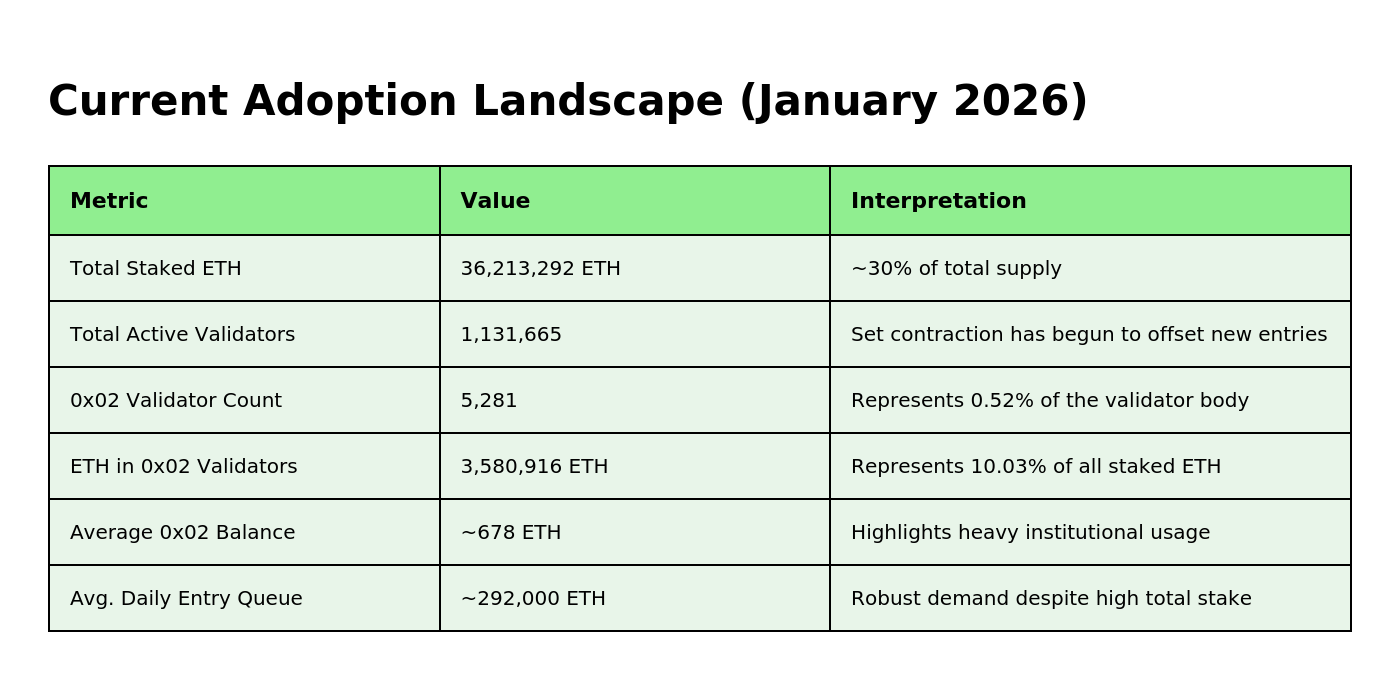
~0.5% of validators use 0x02 credentials:
While only a small fraction of validators have upgraded to 0x02 credentials, these validators already control a disproportionate share of total staked ETH. This asymmetry highlights the intended function of the upgrade. Validator consolidation is not about mass retail migration. It is about allowing large operators to compress redundant infrastructure into fewer, more efficient units.
Average 0x02 validator balance is ~678 ETH:
The average balance of a 0x02 validator is several hundred ETH, confirming that adoption is driven primarily by institutional and professional actors rather than individual stakers. At the same time, the total number of active validators has begun to stabilize, indicating that consolidation is offsetting new validator creation.
This gradual adoption curve suggests that operators are approaching the new model cautiously, validating assumptions about slashing risk, reducing reward variance, and implementing operational changes before fully committing.
Stakeholder Impact: Pros, Cons, and Emerging Risks
Advantages for Validators and the Network
EIP-7251 introduces several structural improvements for both validators and the Ethereum protocol:
- Reduced P2P message bloat and signature aggregation load, extending the effective runway of the consensus layer and lowering the risk of finality delays.
- Improved capital efficiency for validators, as auto-compounding rewards remain effective up to the 2048 ETH cap, delivering an estimated ~1.5% relative APR uplift for long-term stakers.
- Lower operational complexity, particularly for large operators, by consolidating validators and reducing the number of active indices.
- Reduced trust dependency between stakers and operators, as execution-layer-triggered exits allow withdrawal credential holders to initiate exits without operator cooperation.
Disadvantages and Emergent Risks
The upgrade also introduces meaningful tradeoffs:
- Operational concentration risk, as consolidation disproportionately benefits large institutional operators and may increase reliance on high-capacity “supernodes.”
- Regulatory uncertainty, since compounding yield on high-balance validators may strengthen arguments for treating ETH as a yield-bearing financial instrument.
- Increased proposer reward variance for consolidated validators, leading to less predictable short-term cash flows and potentially greater reliance on pooling or liquid staking mechanisms.
Future Outlook: The Road to Glamsterdam and Beyond
The progress made in 2025 has set the stage for the next major milestone in 2026: the "Glamsterdam" upgrade. This future fork is expected to introduce several key technologies that will leverage the more efficient validator set created by EIP-7251.
- Enshrined Proposer-Builder Separation (ePBS): By decoupling block production from block proposal, the network aims to further decentralize the MEV market. The more efficient 0x02 validator set will be crucial for the timely processing of the complex bidding messages required by ePBS.
- Block-Level Access Lists (BALs): This proposal (EIP-7928) aims to improve transaction execution speed by parallelizing transactions. High-balance validators with superior hardware will be the primary beneficiaries and facilitators of this performance boost.
- Real-Time Proving and zkEVMs: The 2026 roadmap involves a shift toward ZK-proof verification for the execution layer. This transition will require validators to move from re-executing blocks to verifying cryptographic proofs, a task that becomes significantly more manageable with the streamlined validator set induced by MaxEB.
By reducing the number of active validators while preserving economic security, Ethereum creates the conditions necessary for these future upgrades to function reliably. In effect, EIP-7251 shifts Ethereum from a phase of validator quantity optimization to one of validator quality and efficiency.
This marks a maturation of Ethereum’s Proof of Stake system. The network is no longer optimizing solely for rapid decentralization, but for long-term sustainability as a global settlement layer.
Conclusion
EIP-7251 represents a decisive evolution in Ethereum’s consensus design.
By replacing the rigid 32 ETH unit model with a flexible, balance-based validator framework, Ethereum has addressed one of its most serious long-term scalability threats. The upgrade improves capital efficiency, reduces network load, and creates a sustainable path toward data-intensive scaling.
While concerns around centralization and regulation remain valid, the technical necessity of this change is clear. Ethereum has chosen pragmatic decentralization over theoretical purity, ensuring that it can continue operating as a secure, permissionless settlement layer at a global scale.
The 0x02 validator is no longer experimental. It is the foundation of Ethereum staking going forward.
