


Ethereum has spent years improving scalability through Layer 2 networks, staking upgrades, and protocol optimizations. But as adoption grows, the network must also continue evolving at the base layer.
That's where Glamsterdam comes in.
Planned for the second half of 2026, Glamsterdam is Ethereum's next major protocol upgrade following Fusaka. Rather than focusing on a single headline feature, Glamsterdam introduces a collection of changes designed to prepare Ethereum for higher throughput, more efficient block production, and future parallel execution.
For validators, developers, and everyday users, the upgrade represents another important step toward a faster and more scalable Ethereum without compromising decentralization.
TLDR
AreaWhat's ChangingL1 ScalingFoundation for parallel transaction processingBlock BuildingEnshrined Proposer-Builder Separation (ePBS)ValidatorsNew validator responsibilities and resilience improvementsUser ExperienceLower ETH transfer costs and better wallet toolingSustainabilityBetter state storage economicsDevelopersImproved multi-chain deployment and tooling
Ethereum's Upgrade Path
Ethereum's roadmap continues to focus on scaling while preserving decentralization.
Roadmap Overview
.png)
While Fusaka focuses on foundational improvements, Glamsterdam targets three major goals:
- Scale Ethereum Layer 1
- Increase network capacity
- Keep node operation sustainable long term
These upgrades help ensure Ethereum can process more activity without making it prohibitively expensive to run a validator or node.
The Biggest Change: Enshrined Proposer-Builder Separation (ePBS)
The most significant proposal currently planned for Glamsterdam is Enshrined Proposer-Builder Separation (ePBS).
Today, Ethereum block production relies heavily on off-protocol infrastructure such as MEV-Boost and external relays.
Current Model
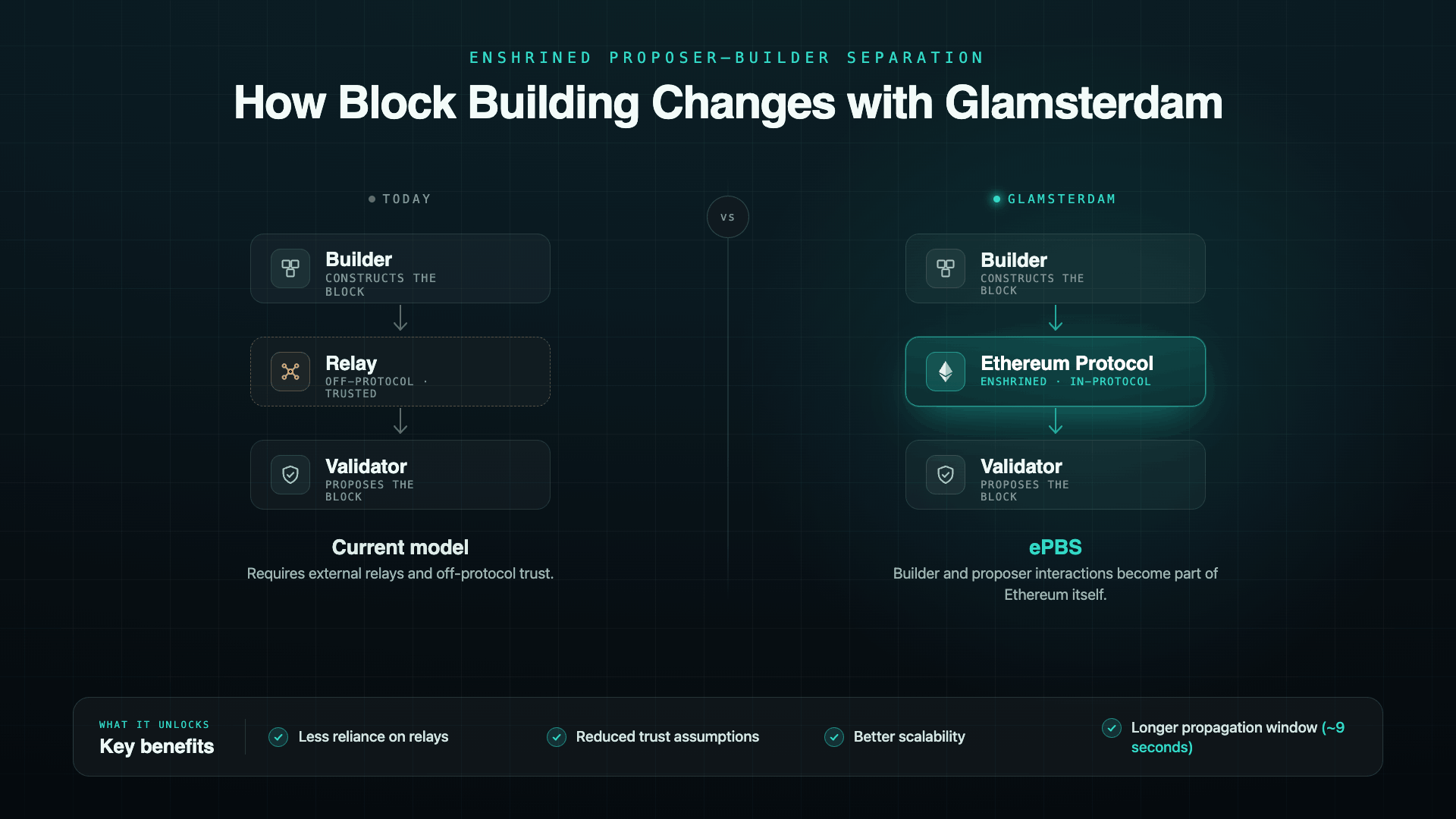
With ePBS, Ethereum moves this process directly into the protocol itself.
This provides several benefits:
- Reduces reliance on third-party relays
- Removes unnecessary trust assumptions
- Creates a more robust validator workflow
- Allows Ethereum to handle larger blocks more efficiently
One of the most important improvements is the expansion of Ethereum's block propagation window from roughly 2 seconds to approximately 9 seconds, giving the network significantly more room to scale.
For many Ethereum researchers, ePBS is the foundation that enables future Layer 1 scaling.
Preparing Ethereum for Parallel Execution
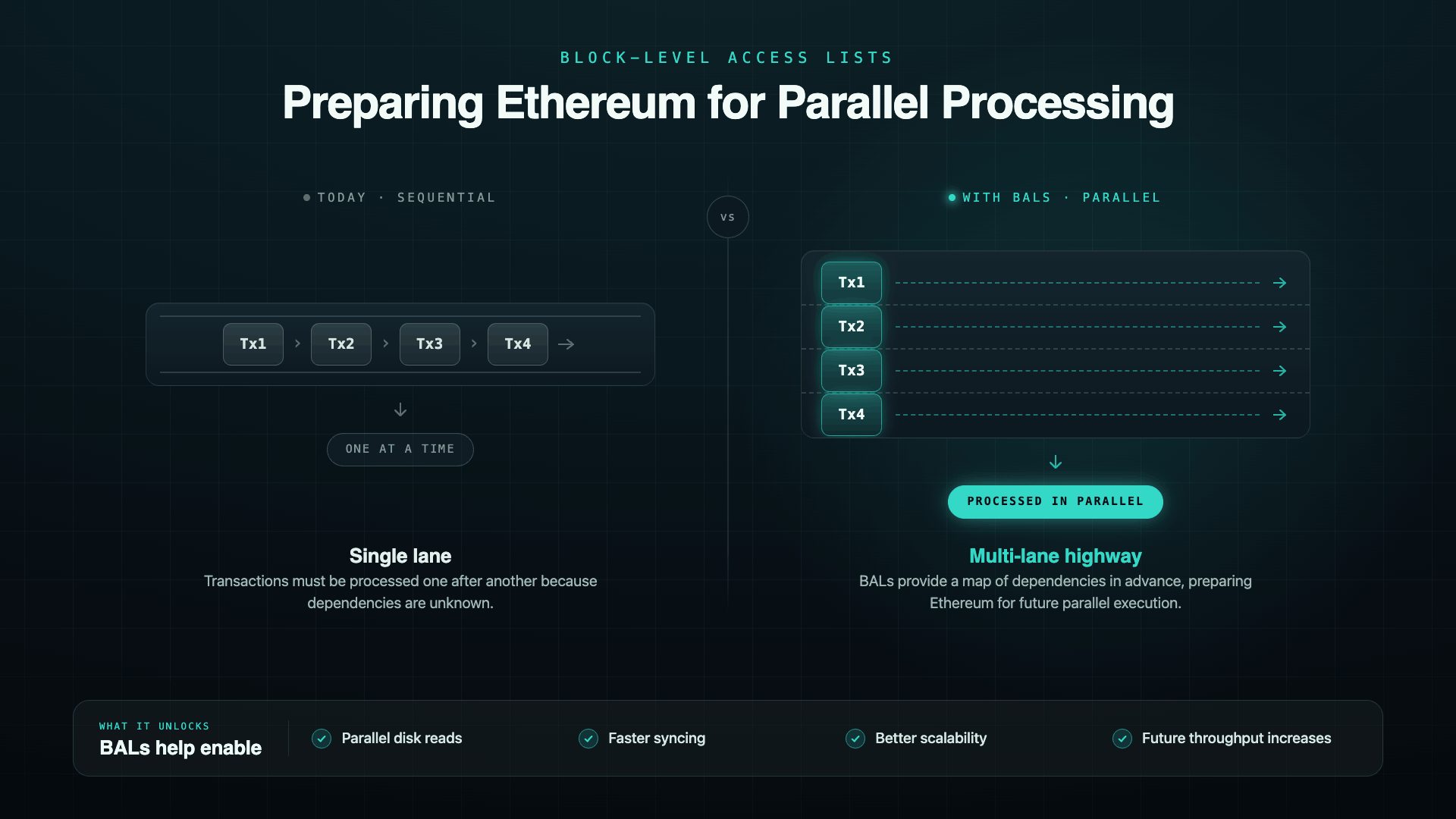
Ethereum processes transactions sequentially today.
In simple terms, the network works through transactions one at a time because it cannot know in advance which parts of the blockchain state each transaction will modify.
Glamsterdam introduces Block-Level Access Lists (BALs) to address this limitation.
Think of BALs as a roadmap that tells validators exactly which accounts and storage locations will be touched before execution begins.
Why This Matters
TodayWith BALsSequential executionParallel-ready architectureDiscover dependencies during executionDependencies known in advanceSlower node synchronizationFaster executionless syncing
While BALs do not immediately make Ethereum fully parallel, they lay critical groundwork for future upgrades that will.
This is one of the reasons many developers view Glamsterdam as a long-term architectural upgrade rather than a simple performance update.
Better User Experience
Not every improvement in Glamsterdam is aimed at validators and infrastructure operators.
Several proposals are focused on making Ethereum easier and cheaper to use.
Lower ETH Transfer Costs
One proposal reduces the intrinsic gas cost of simple ETH transfers between existing accounts.
The goal is straightforward: make everyday ETH transactions more affordable and improve Ethereum's usability for regular payments.
Same Address Across Chains
Another proposal introduces a deterministic deployment factory.
For users, this could mean having the same smart wallet address across multiple Ethereum-compatible networks.
For developers, it dramatically simplifies cross-chain application deployment and user onboarding.
Better ETH Tracking
Ethereum transfers currently lack standardized event logs similar to ERC-20 tokens.
Glamsterdam proposes standardized logs for ETH transfers and burns, making it easier for wallets, exchanges, and applications to track activity reliably.
Keeping Ethereum Sustainable
Scaling Ethereum is not only about increasing throughput.
As the network grows, the amount of data stored by nodes continues to expand. Without proper incentives, state growth could eventually make running Ethereum increasingly expensive.
Several Glamsterdam proposals address this challenge by introducing more accurate pricing for state creation and state access.

Sustainability Goals
ChallengeGlamsterdam SolutionState growthBetter storage pricingDatabase bloatCost-per-byte modelHardware requirementsLong-term sustainability targets
The objective is simple: allow Ethereum to increase capacity while ensuring that node operators can continue participating without requiring enterprise-grade hardware.
Maintaining this balance is critical to preserving Ethereum's decentralization.
What Glamsterdam Means for Validators
Validators will experience some of the most important operational changes from this upgrade.
Because ePBS becomes part of the protocol, both execution and consensus clients will require updates before activation. Validators will need to ensure they are running Glamsterdam-compatible software to remain synchronized with the network.
The upgrade also includes several improvements designed to increase network resilience.
For example, slashed validators will no longer be selected for future proposal duties, helping reduce missed slots during large-scale validator incidents. Additional improvements to validator exit queues are also expected to create a fairer and more efficient staking experience.
Overall, Glamsterdam strengthens Ethereum's validator infrastructure while preparing it for future throughput increases.
Why Glamsterdam Matters
Glamsterdam is not the upgrade that suddenly makes Ethereum process millions of transactions overnight.
Instead, it removes some of the architectural bottlenecks that have historically limited scaling.
Features such as ePBS, Block-Level Access Lists, and improved state management are foundational changes. They prepare Ethereum for future upgrades that can safely increase throughput without sacrificing decentralization or accessibility.
In many ways, Glamsterdam is about preparing Ethereum for the next decade rather than solving the next six months.
Node.Monster's Perspective
At Node.Monster, we closely follow protocol upgrades that improve network performance while preserving decentralization.
What makes Glamsterdam particularly interesting is that it focuses on protocol-level improvements rather than introducing additional trust assumptions. Features such as ePBS and Block-Level Access Lists strengthen Ethereum's core infrastructure while laying the groundwork for future scaling.
As validators, these upgrades help create a healthier, more resilient network. As infrastructure providers, they reinforce Ethereum's long-term vision of scaling without compromising the principles that made the network successful in the first place.
We look forward to supporting Ethereum through the Glamsterdam upgrade and beyond.
